 HintCall Team
On this page
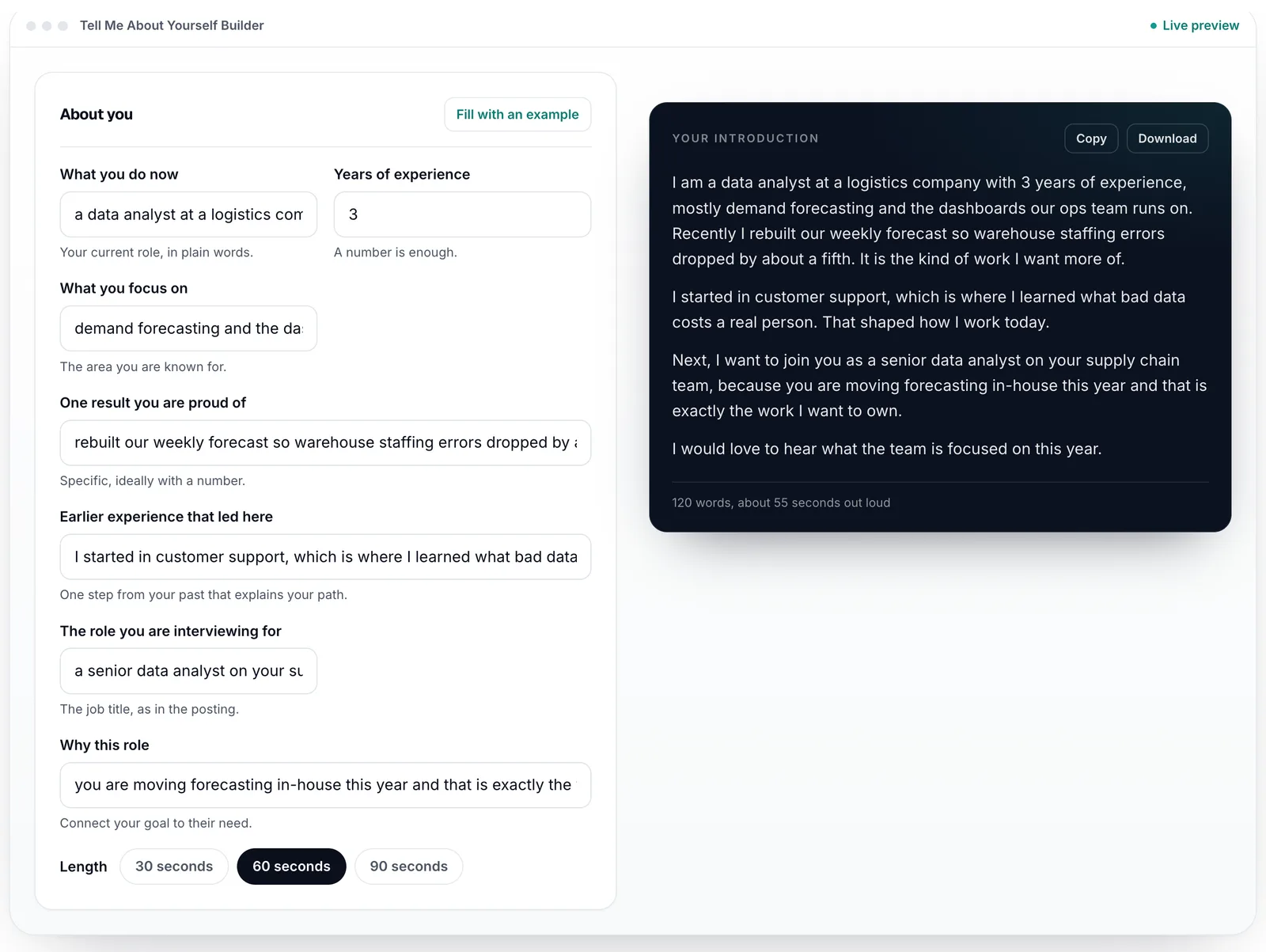
On November 6 we typed a made-up data analyst into our own Tell Me About Yourself builder and pressed nothing else. It gave back 120 words and an estimate of 55 seconds out loud. That’s about the right size for “tell me about yourself.” Time yourself answering it cold and you’ll probably land somewhere north of two minutes.
The question sounds like small talk. It isn’t. It’s usually the first thing you say in the interview, it’s the one answer you can prepare word for word, and a lot of candidates still wing it.
This post covers the structure we use, three sample answers you can borrow from, and the mistakes that show up again and again when people practice it out loud.
What is the interviewer actually asking?
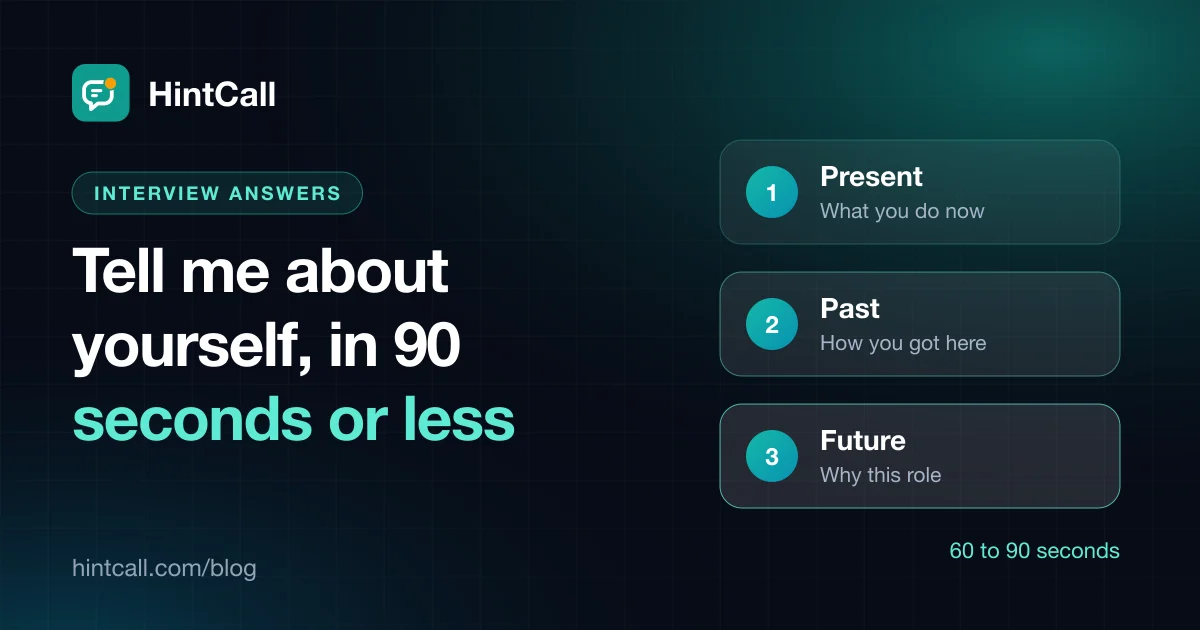
When an interviewer says “tell me about yourself,” they’re asking for a short pitch: who you are at work today, how you got here, and why this role is the next step. They aren’t asking for your life story or a walk through every job on your resume. Keep it to 60 to 90 seconds and end on why you want this job.
There’s a second, quieter thing going on. The first minute sets the frame for everything after it. In a well-known 1993 study, Nalini Ambady and Robert Rosenthal found that strangers watching silent clips of teachers that lasted only 30 seconds made ratings that lined up closely with end-of-term student evaluations. An interview isn’t a classroom, and I don’t want to stretch one paper too far. But it’s a decent reminder that people form a view fast and then look for evidence to back it up.
So the goal of this answer is simple. Give them a frame you’d be happy to have them confirm for the next 45 minutes.
The present, past, future structure
Most good answers fit this shape, and the Indeed career guide on this question recommends a very similar one. It works because it answers the three things the interviewer wants to know, in the order they want to know them.
| Part | What you say | Rough length |
|---|---|---|
| Present | Your current role, what you focus on, one result with a number | 25 to 35 seconds |
| Past | One step from your past that explains how you got here | 15 to 20 seconds |
| Future | The role you want and why this company, specifically | 15 to 25 seconds |
A few notes on each part, since the table makes it look tidier than it is.
Present is where most of the weight goes. Say what you do in plain words (“I’m a backend engineer at a fintech startup”), not in title-speak (“I’m an SDE II, Platform”). Then give one result. A number helps a lot here, even a rough one: “cut failed payments by about a third” lands better than “improved payment reliability.”
Past is one step, not a timeline. Pick the bit of history that makes your present make sense. If you moved from support into data, say that and say what it taught you. Skip the rest.
Future is the part people forget, and it’s the part that gets you to the next question. Connect what you want to what they need: “your team is rebuilding billing this year, and that’s the work I want to own.”
Three sample answers
These are examples, not scripts. Reading someone else’s answer out loud is the fastest way to sound like you’re reading someone else’s answer.
An experienced candidate
Present: I'm a data analyst at a logistics company, three years in, and most of my work is demand forecasting and the dashboards our ops team runs on every morning. Earlier this year I rebuilt our weekly forecast, and warehouse staffing errors dropped by about a fifth.
Past: I actually started in customer support. That's where I learned what bad data costs a real person on the other end of a phone, and it's still why I check my numbers twice.
Future: I'm interviewing for the senior analyst role because you're bringing forecasting in-house this year, and that's exactly the work I want to own next.
That one is the same person we typed into the builder. Here’s what the tool produced from those seven fields:
A fresher or new graduate
Freshers often think they have nothing to say for “present.” You do. Your present is your degree plus the one project you can talk about for ten minutes without notes.
Present: I just finished my B.Tech in computer science, and the project I'm proudest of is a bus-tracking app for our campus. About 400 students used it in the last semester, and I wrote the backend and the part that predicts arrival times.
Past: I got into this through a summer internship where I fixed bugs in a Django app. I liked it more than I expected, mostly because I could see the fix go live the same week.
Future: I'm applying for this graduate role because your team builds the tools your field engineers use every day, and I want my first job to be close to the people using what I build.
A career changer
Career changers get this question with an edge to it. The interviewer is wondering “why the switch?” whether they say it or not, so answer it before they ask.
Present: For the last six years I've been a high school physics teacher, and for the last two I've also run our school's move to a new learning platform, including training 37 teachers on it.
Past: That project is what pulled me toward product work. I spent more time on the platform's feedback forum than on my lesson plans, which told me something.
Future: I'm going for this associate product manager role because you build for schools, and I've been on the user side of exactly this kind of rollout. I know where it breaks.
Mistakes that show up when people say it out loud
Writing a good answer and saying a good answer are different skills. The written version is usually fine. The problems show up in the delivery:
- Starting with your name and hometown. They have your resume. Open with what you do.
- Running long. Unrehearsed answers drift past two minutes easily, and nobody notices while they’re talking, because it feels short from the inside.
- No number. “I worked on forecasting” vs “I cut staffing errors by about a fifth.” Same person, very different impression.
- Ending on the past. If your last sentence is about a job you left, the interviewer has to invent the bridge to this role. Do it for them.
- Sounding memorised. This one is tricky. You should prepare the answer closely, but rehearse the beats, not the exact sentences.
- Apologising for gaps. A career break gets one calm sentence, not three nervous ones.
I’d argue the “sounding memorised” problem is the most common one, and also the most overrated. A slightly rehearsed answer that’s clear beats a natural-sounding one that wanders, every single time. Interviewers can tell you prepared. That’s fine; it shows you care about the job.
How to practice “tell me about yourself” until it sounds like you
Reading your answer silently doesn’t count as practice. You need to hear yourself say it, ideally to something that reacts.
Here’s the loop we’d suggest:
- Write a rough version in the builder above, or on paper, using present, past, future.
- Say it out loud with a timer running. If it’s over 90 seconds, cut the past section first.
- Record yourself once and listen back. It’s uncomfortable. Do it anyway; you’ll hear the filler words immediately.
- Say it to a person, or to an AI interviewer, and let them ask a follow-up question.
That last step matters more than it looks. A good interviewer won’t just nod after your intro. They’ll pick one thing you said and pull on it (“why did you leave support?”), and that follow-up is where unprepared answers come apart.
That’s what our AI mock interview does in its HR round: “tell me about yourself” is one of the questions, the interviewer speaks it out loud, listens to your answer and asks a follow-up based on what you actually said. After the round you get a score and a note on what was missing. You can do the first one free, and honestly, even one spoken attempt with a follow-up teaches you more than ten silent rereads.
One last thing worth saying: you won’t use this answer just once. Expect to give some version of it at the recruiter screen, the hiring manager round and probably a panel, so it’s worth adjusting the “future” part for each person. A recruiter cares about fit and timing. A hiring manager cares about the work. Same story, different last line.
If you only fix one thing after reading this, make your last sentence about them, not you.